
Dental Implants in Hamilton
Natural-looking, long-lasting tooth replacement using titanium implants and custom crowns.
Dental implants replace missing teeth at the root level. Once integrated with your jawbone, the implant supports a custom crown that looks, feels, and functions like a natural tooth.
- Single Tooth Implants
- Multiple Implants
- Implant-Supported Bridges
- Full-Arch Implants
- Bone Grafting
- Implant Restoration
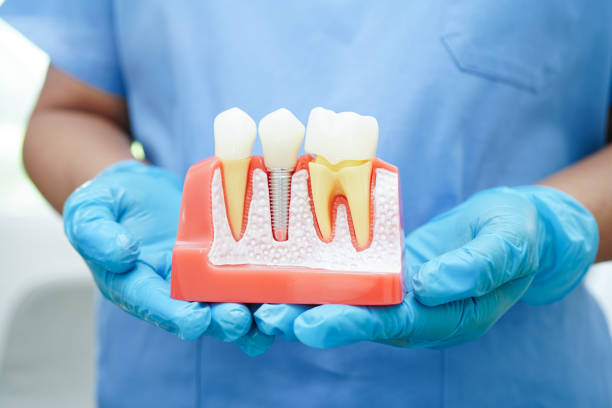
How a dental implant replaces a missing tooth
A dental implant is a small biocompatible titanium post that's surgically placed in the jawbone. Over a few months it fuses with the bone (osseointegration), then we attach a custom crown, or, for multiple missing teeth, an implant-supported bridge or denture.
Who dental implants is good for
- Replacing one or more missing teeth
- Patients tired of removable dentures
- Preventing bone loss in the jaw after extraction
- Preserving adjacent teeth (no need to grind them down for a bridge)
What to expect
- Consultation & 3D scan. We assess your bone, gums, and bite to confirm you're a candidate.
- Implant placement. The titanium post is placed in the jawbone under local anesthetic, with sedation if you prefer.
- Healing & integration. The implant fuses with the bone over 3–6 months.
- Crown placement. A custom crown is attached, blending perfectly with your natural teeth.
How we plan an implant case
Implants succeed or fail on the planning. Before we place anything we do a 3D cone-beam CT scan of the area to see the bone height, bone width, the position of the inferior alveolar nerve in the lower jaw, and the floor of the maxillary sinus in the upper jaw. We measure the available bone in millimetres and plan the implant length and angle around what is actually there, not what is convenient.
For most cases we use a surgical guide printed from the scan. The guide drops over your existing teeth and tells the drill exactly where to go and how deep. It is the difference between a precise restoration and one that ends up at the wrong angle, which is a problem you only discover months later when the crown is being made.
Brands and components we use
We work with Dentsply Sirona Astra Tech dental implants. The Astra Tech system has decades of long-term outcome data, a well-established prosthetic library, and components a future dentist anywhere in Canada will be able to source if a screw ever loosens or a crown needs replacement ten years from now. Choosing a major, well-supported system matters more than people think; boutique or no-name implant systems can cost less up front but leave you stranded if the manufacturer disappears.
For the connection between implant and crown we use titanium or zirconia abutments depending on the aesthetic zone, and we cement or screw-retain the crown depending on the case. Screw-retained is easier to repair later if the porcelain ever fractures.
When bone grafting is part of the plan
If a tooth was lost more than a year or two ago, there is usually some bone loss. A small graft (autograft from the area or a particulate xenograft) placed at the same visit as the implant is routine. A larger ridge augmentation or a sinus lift is a separate procedure done a few months before the implant.
If your scan shows good bone, you do not need grafting and we will not recommend it.
Full-arch options for patients missing many teeth
For patients losing or already missing most of their upper or lower teeth, the choice is usually between a conventional denture, an implant-retained denture that snaps onto two to four implants, or a fixed full-arch bridge supported by four to six implants (often called All-on-4). The fixed option feels closest to natural teeth and never comes out. The snap-on option is a major upgrade from a conventional denture at a more accessible price. We walk through every option at the consultation along with what your scan can actually support, and share a written estimate before any treatment.
Implant maintenance and what can go wrong
The biggest long-term risk to an implant is not the implant itself, it is the gum and bone around it. Peri-implantitis behaves like gum disease around a natural tooth. It is silent in the early stages and can lead to bone loss if not caught. Patients with implants need a hygiene visit every three to four months for the first year or two and at least every six months after that, with a probing check and an annual X-ray on each implant. We use plastic or titanium scalers around implants, never stainless steel, because steel scratches the implant surface and gives bacteria a place to grip.
Insurance and CDCP for implants
Most private dental plans cover the crown portion of an implant (typically 50 percent) but vary widely on the surgical placement. We submit a pre-authorization with the CBCT and treatment plan so the insurer responds in writing with what they will pay. CDCP does not currently cover implants in most cases, though they cover the underlying extraction if a tooth needs to come out first. 0% financing is available for whatever insurance does not cover.
Frequently Asked Questions
How long do dental implants last?
With proper care, dental implants are one of the most durable tooth replacements in dentistry and commonly last 20 years or more. They are long-lasting but not permanent: the titanium post fuses with your jawbone, while the crown attached to it can wear and may need replacement over time. Routine hygiene cleanings and a nightly home-care routine are what keep them healthy long term.
Is implant surgery painful?
The procedure is done under local anesthetic, with the option of nitrous oxide sedation if you're anxious. Most patients describe recovery as easier than a routine tooth extraction, with mild soreness for two to four days that responds well to over-the-counter pain relievers.
Am I a candidate for dental implants?
Most healthy adults with sufficient jawbone are candidates. If bone loss is a concern, bone grafting can rebuild the area before implant placement. Book a consultation and we'll review your 3D scan and medical history before recommending a plan.
How are dental implants priced and what does insurance cover?
Cost depends on the number of implants and whether grafting is needed. After your consultation we share a clear written estimate so you know exactly what to expect before anything begins. We provide direct insurance billing if applicable, and 0% financing for qualifying patients is available for any out-of-pocket portion. CDCP does not typically cover implants, but private insurance plans often cover part of the crown.